How Stage Melodrama Shaped the Early Western
Stage melodrama shaped the early Western through clear conflicts, bold entrances, and readable stage pictures; learn how filmmakers adapted those tools for the screen.
Stage melodrama shaped the early Western by giving filmmakers familiar ways to stage conflict, character, and public action. The connection is easiest to see in the silent era, when films such as The Great Train Robbery (1903) and The Squaw Man (1914) used theatrical performers and recognizable dramatic situations while building stories for the camera.
There was no single stage blueprint for the genre. Touring melodramas, frontier plays, and popular spectacles offered different conventions, and surviving films do not always reveal which particular production influenced a scene. The useful comparison is more modest: both stage and screen could make a conflict readable through an entrance, a prop, a clear arrangement of performers, or a decisive action. Film then changed how viewers saw those elements.
How did stage melodrama make conflict visible?
Melodrama gave audiences clear stakes and sharply opposed purposes. A dishonest land claim, a threatened household, or a community under pressure could be understood through visible action: someone takes a document, blocks a doorway, or arrives with news. These are conventions of dramatic staging, not proof that every early Western borrowed a specific plot from a play.
One useful period example is Edwin S. Porter’s The Great Train Robbery, a short film made for Edison in 1903. Its linked scenes turn a robbery, pursuit, and confrontation into legible screen action. The film is not simply a stage play transferred intact; its changes of setting and views make the camera part of the storytelling.
A deed, a stolen horse, or control of a road can also make a broad question about power tangible. The object works like a key on a kitchen table: whoever holds it changes what can happen next. That focus helps an audience follow the dispute without requiring a long explanation.
What did touring frontier plays contribute?
Touring plays carried frontier settings and conflicts to audiences in different towns. Their stories could rely on familiar situations—travel, settlement, danger, or a struggle to establish local order—so a company did not have to explain every detail of the setting before the dramatic action began. The existence of such plays is part of the larger stage context, but it does not establish a direct source for any particular film unless that link is documented.
Film could use a similarly economical opening: a remote settlement, a vulnerable home, or a lawless road, followed by the threat that disrupts it. Unlike a touring company, a film could move between locations through cuts, without showing a theatrical scene change. The familiar situation remained, while the means of presenting it changed.
For a named point of comparison, The Squaw Man began as a stage play by Edwin Milton Royle and was adapted for film in 1914, with Cecil B. DeMille among its directors. That documented path from stage play to screen is different from the broader claim that stage conventions influenced Westerns generally; it gives a specific case of adaptation rather than a universal rule.
Why were familiar character roles useful?
Melodramas often used recurring functions: the wronged person, the schemer, the loyal helper, or the newcomer whose intentions are unclear. These roles gave an audience a starting point, not a complete account of a person. An actor could complicate a familiar type through hesitation, humor, or an unexpected choice.
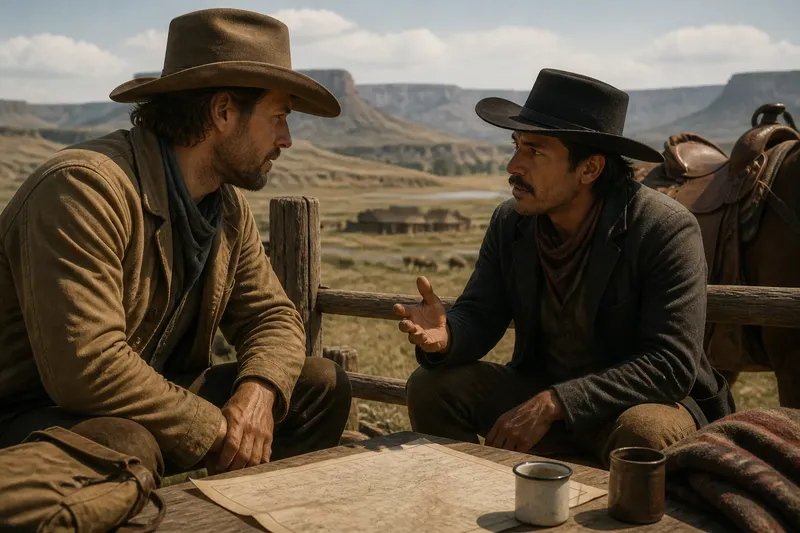
Imagine a fictional Western scene in which a new ranch hand enters town and is treated as a likely troublemaker. The person quietly returns a child’s dropped keepsake before anyone notices. That action gives viewers a reason to reconsider the first impression, while the familiar outsider role keeps the scene easy to follow. This invented situation illustrates a storytelling possibility, not a claim about a specific historical film.
Silent-film performance also made gesture and timing especially important. A glance, pause, or movement could clarify a character’s reaction without spoken dialogue. The camera’s framing could bring that detail forward, allowing a screen performance to be more restrained than a gesture intended to reach the back of a theater.
How did stage spectacle become screen action?
Popular theater used costumes, props, music, entrances, and physical action to hold attention. The resources varied by company and production, so it is safer to describe a shared aim than to assume every touring show used the same devices: make important changes visible and keep the action moving.
Early Western films could preserve the impact of a rider’s arrival, a hurried message, or a struggle over an object. But the camera was not simply a theater spectator’s seat. A filmmaker could choose a closer view, change the angle, or cut to a reaction, giving the same dramatic beat a different emphasis.
Porter’s The Great Train Robbery provides a concrete example of the screen’s capacity to organize action across settings. Its scenes connect the robbery to pursuit and confrontation rather than keeping the event within one theatrical playing space. That does not mean film discarded theatrical showmanship; it means filmmakers could rearrange attention with location and editing.
What could a stage picture tell the audience?
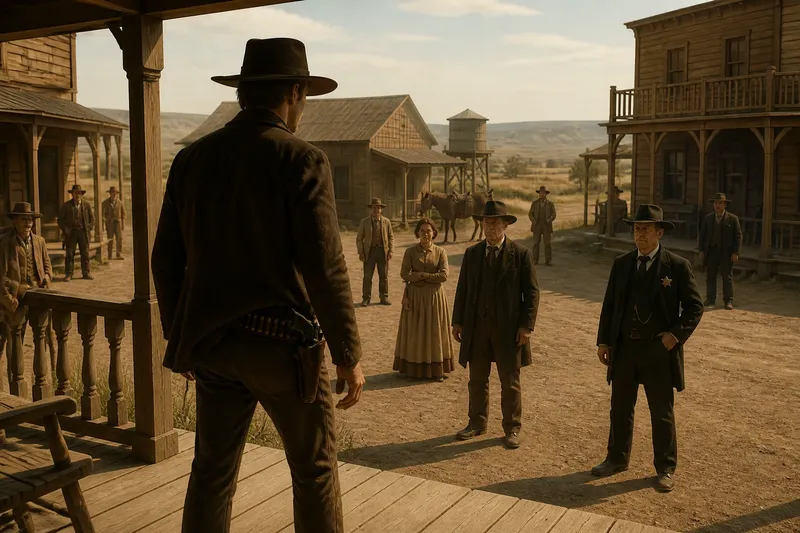
Onstage, performers’ positions could make relationships visible. Who stood at the center, who stayed at the edge, and who stood beside an authority figure might help communicate rank or allegiance. Blocking—the planned movement and placement of performers—was part of how a scene told its story.
Film could preserve a group arrangement or isolate one person in a closer view. A solitary figure entering a public room might signal a challenge before anyone speaks; a camera cut to a listener could show that the challenge has landed. Props could carry similar weight: a letter, badge, or chair might indicate who has information or control, while framing directs the viewer toward it.
These comparisons describe ways of reading scenes, not a claim that every early Western followed the same visual formula. The details of a particular production matter, and the surviving record may not identify its theatrical influences.
How did the camera change stage conventions?
A stage scene usually unfolds in a shared space, while film can divide action across shots and locations. A stage performer may need a larger gesture to make an action legible across a theater; a film actor can communicate through a smaller expression when the camera gives it prominence. The underlying dramatic event—a discovery, entrance, or reversal—can remain recognizable even as its presentation changes.
Imagine a fictional scene built around a missing letter. Onstage, one character searches a table while the audience watches the whole room. In a film version, the director first shows the search, cuts to the letter caught beneath a boot, then shows a witness noticing it. The starting situation is the same, but the film version distributes information through editing and changes what the audience knows at each moment. This is an invented illustration, not a historical production.
What do readers ask about stage roots of Westerns?
Did early Westerns simply film stage plays?
No. Some screen works adapted named stage plays, as The Squaw Man did, while many others used familiar dramatic conventions without being direct adaptations. Film could shift location, viewpoint, and pacing.
What does melodrama mean in this context?
It refers to a popular dramatic mode that makes conflict and stakes readily visible, often through strong reversals and decisive action. A Western might use that structure for a dispute about property, safety, or local authority.
Why use stock characters?
A familiar role helps viewers understand a scene quickly, but it does not dictate what a character will do. A surprising decision can challenge the expectation that the role first creates.
What did film add to stage storytelling?
Film could select a closer view, move between locations, and distribute information through editing. Those choices altered how viewers experienced a familiar entrance, discovery, or confrontation.
How can you recognize stage roots in an early Western?
- Observe whether a conflict centers on a visible object, such as a letter or deed; if the object changes hands, then track how that changes control, or, if it remains untouched, look for another action that drives the dispute.
- Observe how a newcomer is introduced; if other characters react before the newcomer speaks, then read those reactions as the scene’s first clues, or, if they do not, wait for the character’s own action to establish a role.
- Observe where performers stand in a public room; if one person occupies the center or controls an entrance, then consider what authority the arrangement suggests, or, if positions are scattered, follow movement and dialogue for the relationship.
- Observe whether a decisive entrance changes the scene; if it interrupts an ongoing action, then note what new information or pressure arrives, or, if nothing changes, treat it as an introduction rather than a turning point.
- Observe how the film presents a discovery; if a cut reveals information the characters have not noticed, then follow the gap between audience knowledge and character knowledge, or, if the whole event remains visible, focus on performance and movement.
- Observe whether a close view singles out a face or prop; if it does, then ask what detail the filmmaker wants viewers to notice, or, if the shot keeps the group together, read the relationships within the shared frame.
For a worked invented example, imagine an early Western scene with a town clerk, a rancher, and a folded land deed. The starting situation is that the clerk holds the deed while the rancher argues from across the room. First, observe the prop: the clerk controls the document, so the rancher cannot settle the dispute by assertion alone. Next, observe the blocking: if the clerk remains at the center, the scene presents that office as a source of authority; if the clerk steps aside, the balance visibly shifts. Finally, watch the framing: a close view of the deed would direct attention to its importance, while a wider view would keep the three people’s positions in focus. The resulting reading is conditional on what the imagined scene actually shows; the scene does not establish a historical claim about a real film.
Why do stage roots still matter?
Recognizing the stage roots of the early Western helps explain why entrances, confrontations, visible props, and clear arrangements of people can make a story immediately readable. The screen did not merely preserve those devices: framing, movement, and editing changed how each one worked.
When watching an early Western, notice what the scene lets you understand before anyone explains it. A character’s entrance, the handling of a letter, or the distance between rivals can show how a familiar theatrical convention became film storytelling. Looking for those choices also keeps the historical claim in proportion: a scene may resemble stage practice without proving that a filmmaker borrowed it from a particular play.