A Quiet Western Evening: Listen for the Sounds Between Lines
Learn how to listen to a Western scene’s wind, footsteps, pauses, and room tone, so nonverbal sound reveals tension, distance, and changing relationships.
A quiet Western scene can tell you who feels trapped before anyone speaks. Listen for the wind against a door, a boot shifting in dust, or the beat of room tone after a line ends. These sounds between lines are not empty space; they shape how a scene feels and what you notice.
Try this focused viewing plan with one scene rather than a whole film. Keep your attention on sound, then connect what you hear to the characters’ behavior and the space around them. You do not need technical equipment: a normal playback setup and a willingness to pause are enough.
What counts as sound between lines?
Sound between lines includes every audible detail that is not spoken dialogue or music. A horse’s tack creaking, cloth brushing against a saddle, a chair scraping the floor, and the faint sound of wind all belong. So does the quiet that remains when those noises stop.
That last kind of quiet is often called room tone: the underlying sound of a location, whether it is an interior or an open landscape. A room may carry a soft hiss, a draft, or distant activity. Outdoors, the bed of sound may include wind, insects, or a far-off animal. It need not be perfectly silent to feel still.
Think of the sound bed like the paper beneath a drawing. You may barely notice it, but remove or change it and the whole image feels different. A scene can use that background to make a pause feel comfortable, watchful, or uneasy.
How should you listen to a Western scene?
First, watch the scene once without pausing. Notice which moment feels most charged, even if nothing dramatic happens on screen. A character may be sitting at a table while another remains just inside a doorway; your first response gives you a useful place to listen more closely.
Then replay the passage and take it in layers. Avoid trying to identify every sound at once. Give each pass one simple job:
- Listen for the background. Notice whether wind, insects, or interior room tone stays steady or changes.
- Follow movement. Track steps, clothing, saddles, doors, cups, or other objects that move in the scene.
- Watch the gaps. Listen to what happens just before and after a line, especially when a character hesitates.
- Return to the picture. Ask which visible action or expression makes a sound newly significant.
If you are watching with other people, one pass with the volume at a comfortable level can help. For a solo session, ordinary speakers or headphones both work; choose whatever lets you hear the scene without straining. The aim is attention, not a special listening setup.
What does wind tell you when nobody speaks?
Wind can make a location feel exposed, but its meaning depends on what the scene does with it. A steady rush may simply establish an open, unsettled place. A sudden gust that fills a pause can make a character’s stillness feel deliberate, as if the landscape has become part of the conversation.
Notice whether the wind is continuous or intermittent. If it dies away when a character turns toward a companion, the change can draw attention to that glance. If it keeps rattling a shutter while both characters remain quiet, it may make the room feel less secure without changing anyone’s posture.
Also ask what the wind touches. Dust brushing a porch, a loose sign tapping, and grass moving outside a window each connect the sound to a particular part of the setting. The detail can make an off-screen space feel present, even though the camera stays on the people.
How do footsteps and small movements change a scene?
Footsteps tell you about more than arrival or departure. Their pace, weight, and distance can suggest whether a character is confident, cautious, tired, or trying not to be noticed. Listen for the surface too: boards, packed earth, gravel, and loose dust create different impressions of the same walk.
Small movements can be just as revealing. A boot that shifts under a table, a hand that brushes a holster, or a cup set down with care may mark a decision before the character says anything. These sounds do not prove what the person intends; they give you something concrete to compare with the face and dialogue.
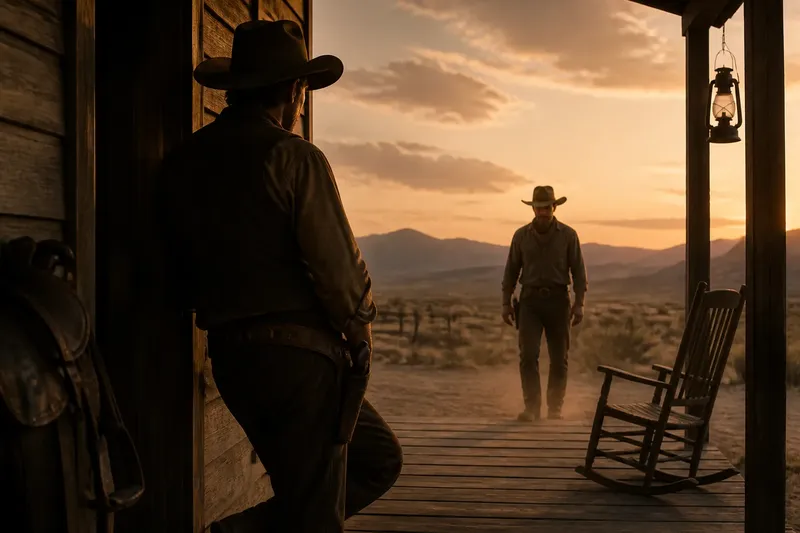
Imagine a scene in which one ranch hand waits by a stable door while another approaches across a wooden porch. On the first viewing, the exchange seems polite. On replay, suppose the approaching hand’s steps stop short, while the waiting hand’s boot scrapes the boards just before a guarded reply; those sounds could make the greeting feel more cautious than the words alone.
Why do pauses sometimes feel louder than dialogue?
A pause feels active when you can hear what continues through it. A character may stop speaking while a horse shifts nearby or a fire crackles indoors. Those sounds hold the scene in motion, so the silence is not a blank interval but a stretch in which everyone seems to be listening.
Compare the same pause with the sound bed in mind. Does a character speak over the wind, wait for a door to close, or answer only after another person moves? Such timing can suggest reluctance or attention. It can also make a simple exchange feel intimate, because the characters share a moment without filling it with words.
Silence can also draw a boundary. When background sound falls away, you may feel cut off from the surrounding place and focused on a face or gesture. When ambient sound remains, the characters seem to exist within a larger world, not in a sealed bubble. Neither choice has one fixed meaning; look at how the actors and scene use the pause.
How can you tell whether a sound is part of the setting?
Listen for repetition and response. A sound that recurs in the same space may be part of its ambient bed; a sharp sound that interrupts a line may have been placed to catch your attention. The image can help you judge: a swinging sign might account for a repeated tap, while a character’s reaction may point to a new sound outside the frame.
Sometimes the source stays unseen. That does not make the sound meaningless or mysterious by default. It may simply suggest that the scene extends beyond the visible frame. Notice whether anyone reacts, whether the sound continues, and whether the camera holds on a listener. Those cues help distinguish a detail that characters register from one that mainly shapes the audience’s mood.
Pay attention to perspective, too. A sound may seem distant while a character is turned away, then grow clearer as they face its source. Changes in loudness can guide your attention, but avoid treating them as a literal map of distance: the scene’s sound mix may emphasize an event for dramatic clarity.
Which questions help you read nonverbal sound?
What should I listen for in a Western’s room tone?
Notice the quiet background that continues beneath speech and movement. Ask whether it feels enclosed, breezy, busy, or unusually still, then see how that texture affects the scene.
Do footsteps matter if the camera does not show them?
Yes, an unseen step can make a character react to someone outside the frame. Listen for the direction and timing of the response, but treat your reading as a possibility rather than a certainty.
Does silence mean the soundtrack has stopped?
Not necessarily; silence may still contain wind, room tone, or a faint animal sound. The useful question is what remains audible and whether that background changes around the characters.
Should I watch with headphones to catch subtle sounds?
Headphones can make quieter details easier to distinguish, while speakers may help you hear the scene as a shared room experience. Use either option at a comfortable level and focus on the pattern of sounds, not on hearing every faint detail.
What should you do after listening?
Choose one sound that changed how you read the scene and replay only the moment around it. Name the sound, note when it appears, and describe the visible response that follows. Keeping your observation specific—“the porch board creaks as the visitor stops”—is more useful than deciding that the whole scene simply feels tense.
Then consider an alternative reading. A pause might signal distrust, but it could also reflect fatigue or a character waiting for the other person to finish. Let the sound support your interpretation without turning it into a verdict about motive.
Listening this way makes a quiet Western evening feel more legible. Wind, footsteps, and pauses can show how people share space, avoid one another, or hold back a reply. The next time a scene seems still, stay with the sound after the dialogue ends; a small creak or steady draft may be the detail that keeps the moment alive.